Introduction
YouTube stands as the world's most-watched video platform, boasting over 2 billion logged-in users monthly. Despite its immense scale and integration within Google Ads, YouTube advertising often remains an undertested and underinvested channel in many campaign portfolios. In 2026, overlooking YouTube's potential carries increasing costs.
The platform has undergone substantial updates in the past year, including new bidding models, expanded Shorts placements, mandatory Enhanced Conversions, and advanced AI-driven optimization systems. These changes are creating notable performance disparities between early adopters and those relying on manual setups. This guide provides a comprehensive overview to help you build a YouTube Ads strategy that delivers measurable results in 2026.
Key Changes in YouTube Ads (2025–2026)
Several platform updates have significantly reshaped YouTube advertising performance:
- Enhanced Conversions Mandatory for Performance Max (November 2025): Advertisers utilizing Performance Max campaigns with YouTube inventory must now implement Enhanced Conversions. This server-side conversion data enhances attribution accuracy. Accounts without this implementation may be under-reporting YouTube-driven conversions.
- Target CPM (tCPM) Bidding Expansion: The tCPM bidding model, which optimizes for unique reach rather than views or clicks, is now more broadly available. Early implementations have indicated a potential for increased unique reach at similar budget levels, with the algorithm effectively managing frequency and identifying lower-cost inventory during off-peak periods.
- YouTube Shorts in Demand Gen Campaigns: Shorts placements are now integrated into Demand Gen campaigns. Initial testing in January 2026 suggested these placements could achieve a lower CPA compared to standard in-stream placements, while maintaining comparable conversion rates.
- Autonomous AI Optimization Advantage: Accounts leveraging AI-driven optimization tools for YouTube campaigns have shown a tendency towards improved CPA compared to manually managed accounts, with even greater potential for accounts with substantial YouTube inventory in Performance Max.
YouTube Ad Formats in 2026: Choosing the Right Tool

Skippable In-Stream Ads
These ads play before or during YouTube videos and can be skipped after 5 seconds. Charges apply only when a viewer watches 30 seconds (or the full ad if shorter) or clicks. This makes skippable in-stream ads a cost-efficient format for awareness and consideration, as you only pay for engaged views.
The initial 5 seconds are crucial: if your hook fails to generate sufficient curiosity or relevance, the ad may be skipped without cost, but also without impact. Invest heavily in these first moments. Employ a pattern interrupt, a bold statement, a specific problem callout, or a visually striking image to encourage continued viewing.
Non-Skippable In-Stream Ads (15 seconds)
Non-skippable ads guarantee a complete view but typically incur higher costs per impression and carry a greater risk of audience resistance. They are best suited for high-awareness objectives such as product launches, brand campaigns, and event announcements where message completion is essential. Avoid using them for bottom-funnel direct response, where the cost-per-action may not justify the format.
YouTube Shorts Ads
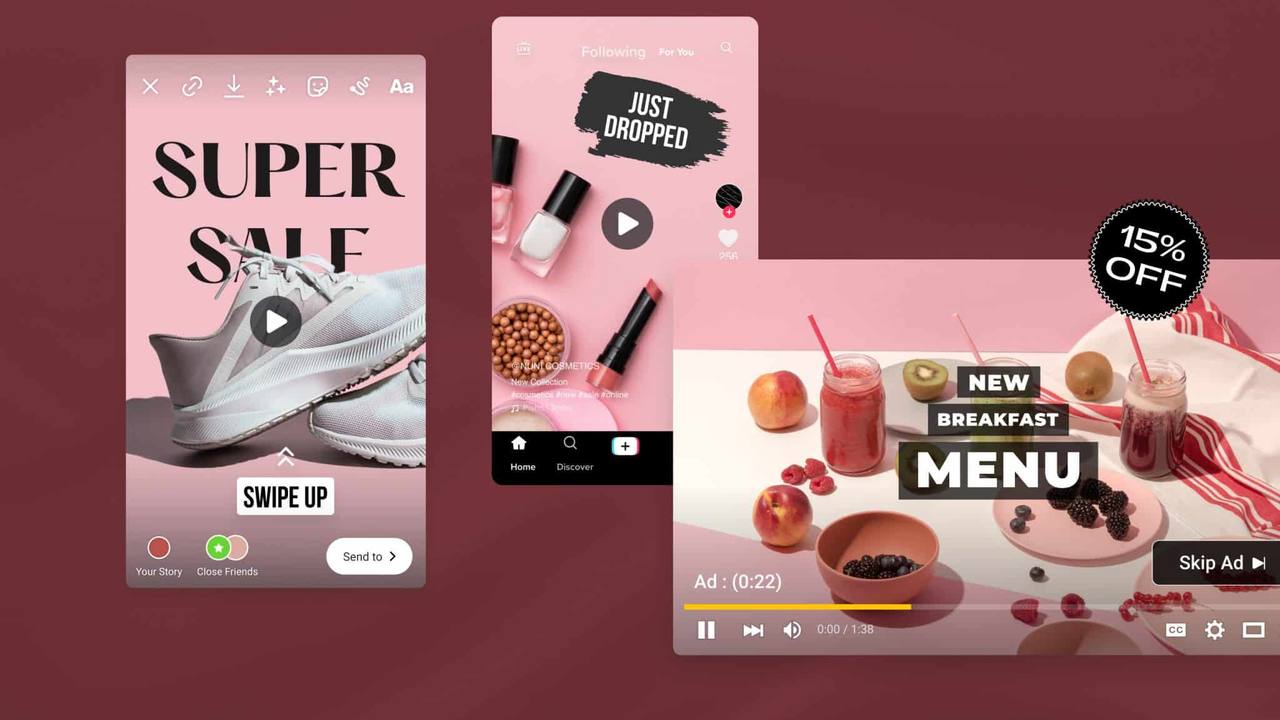
YouTube Shorts, the platform's vertical short-form video surface, represents a significant growth opportunity for advertisers in 2026. Shorts ads appear natively between user-generated content in a full-screen vertical format. Due to the relative undersupply of Shorts ad inventory compared to demand, CPMs can be lower and engagement rates higher than traditional in-stream ads.
Best practice: Repurpose your top-performing TikTok or Instagram Reels content as YouTube Shorts ads. Vertical, native-feeling creative tends to perform best. Keep videos under 60 seconds, lead with energy and visual movement, and place your key message and call-to-action (CTA) within the first 10 seconds.

Bumper Ads (6 seconds)
Bumper ads are 6-second non-skippable ads designed purely for brand recall and awareness reinforcement. They are most effective as part of a sequenced campaign strategy, used to reinforce a message after a viewer has already seen a longer-format ad. While bumper ads rarely drive direct response on their own, they can consistently improve brand lift and purchase intent metrics when integrated into a funnel sequence.
Demand Gen Campaigns: YouTube + Discovery + Gmail
Google's Demand Gen campaign type (formerly Discovery Ads) now encompasses YouTube (in-stream and Shorts), the Google Discover feed, and Gmail. For advertisers seeking to run YouTube ads without managing the complexity of standalone video campaigns, Demand Gen offers a simpler entry point with robust AI-driven placement optimization.
The Shorts placement advantage within Demand Gen is noteworthy in 2026, with early testing suggesting a potentially lower CPA compared to standard YouTube in-stream. Prioritize allocating budget to Demand Gen campaigns with Shorts enabled as a key test if you haven't already.
The YouTube Ads Creative Framework for 2026
Creative quality is a paramount factor, potentially accounting for a substantial portion of YouTube campaign effectiveness, according to internal research. While campaign optimization is important, strong creative is indispensable; no bidding strategy or audience configuration can fully compensate for weak creative.
Proven YouTube creative structure:
- Hook (0–5 seconds): Disrupt the passive watching state. Use movement, a bold statement, a direct address ('If you're a [persona]...'), or an unexpected visual. This is your primary opportunity to prevent a skip.
- Problem or Desire (5–15 seconds): Identify the specific pain point or aspiration of your target viewer. Be precise; generic problem statements often have low resonance.
- Solution + Proof (15–45 seconds): Introduce your product or service as the answer. Demonstrate its functionality. Utilize demonstrations, testimonials, or before/after comparisons to build credibility.
- CTA (Final 5–10 seconds): Clearly instruct the viewer on the next action. Use a concise, simple call-to-action: 'Click below to get your free trial,' 'Visit [site] today,' 'Download the guide now.'
Audience Strategy: Layering for Funnel Precision
YouTube's audience targeting capabilities in 2026 are extensive. A recommended approach involves layering multiple signals for precision without excessive restriction:
- Custom Intent Audiences: Target users who have recently searched specific keywords on Google. This is often considered a powerful YouTube targeting option for capturing search intent within a video context.
- Customer Match: Upload your first-party customer and prospect lists to exclude existing customers from acquisition campaigns or re-engage warm prospects.
- In-Market Audiences: Reach users Google has identified as actively researching products in your category.
- Topic and Placement Targeting: Directly target specific YouTube channels or content categories. This can be highly effective for niche B2B verticals and specialized consumer categories.
- Remarketing: Retarget users who have visited your website, watched your YouTube videos, or engaged with your channel. This is exceptionally powerful for high-consideration purchases requiring multiple touchpoints.
Budget Allocation: YouTube as a Funnel Investment
For brands running integrated Google campaigns, a practical YouTube budget allocation framework by funnel stage might look like this:
- Awareness (approx. 40% of YouTube budget): Bumper Ads + broad Skippable In-Stream targeting via tCPM bidding. Goal: unique reach and frequency building.
- Consideration (approx. 35%): In-stream to warm audiences (Custom Intent + In-Market). Goal: product education and intent deepening.
- Conversion (approx. 25%): Remarketing campaigns to site visitors and video viewers with a direct CTA. Goal: last-touch conversion or assisted conversion attribution.
It is advisable to allocate YouTube budget separately from Google Search, as they serve distinct funnel roles and ideally should not compete within the same Performance Max campaign.
Implement Enhanced Conversions Before Anything Else
If you are running any YouTube campaigns in 2026 and have not yet implemented Enhanced Conversions, this should be a top priority. Enhanced Conversions send hashed first-party data (email, phone) from your conversion events back to Google, significantly improving attribution accuracy in a cookieless environment.
Without Enhanced Conversions, Google's algorithm may be optimizing towards an incomplete conversion signal, potentially degrading the effectiveness of your targeting, bidding, and audience optimization. Implementation is typically done via Google Tag Manager and can often be completed quickly by a proficient technical marketer.
Conclusion
YouTube Ads in 2026 reward advertisers who skillfully combine strong creative, AI-assisted optimization, and a clear funnel strategy. The platform has evolved significantly, creating a widening performance gap between those who leverage it effectively and those who rely on outdated campaign approaches.
Begin by implementing Enhanced Conversions, test Shorts placements in Demand Gen, structure your creative around the crucial 5-second hook rule, and allow YouTube's AI optimization systems to work synergistically with your data. The advantage for early movers on this platform continues to grow each quarter.
Ready to elevate your YouTube advertising strategy? Partner with GerenciAds to unlock the full potential of your video campaigns and drive superior conversion performance in 2026. Contact us today for a personalized consultation and discover how our expertise can transform your results.
Need help applying this to your campaigns?
GerenciAds helps businesses turn strategy into practical account improvements, clearer measurement, and more reliable growth. Contact us if you want support turning these ideas into action.